

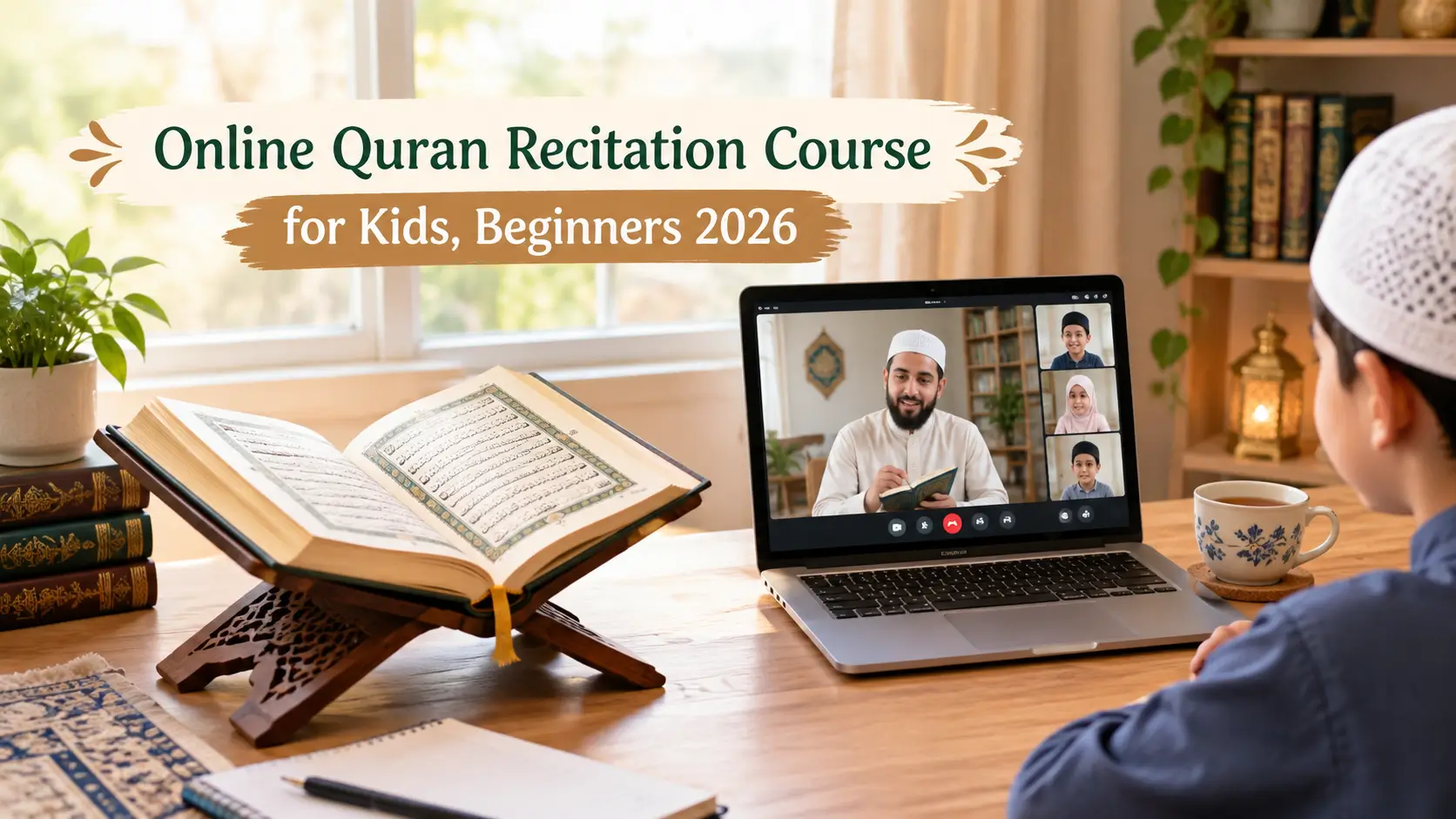
Learning to recite the Quran correctly is not something most people can pick up from a book alone. Recitation has rules — pronunciation, pauses, letter sounds — and those rules are much easier to learn from a real teacher who can listen and correct you. That’s exactly the gap an online Quran recitation course is built to fill.
If you’ve been searching for a way to learn recitation without leaving your home, you’ve probably noticed the sheer number of options out there. Some are excellent. Some are just websites collecting your email address. This guide walks you through what an online Quran recitation course actually involves, what a good one looks like, and how to avoid wasting your time and money.
In short: An online Quran recitation course is a structured program, usually delivered through live video sessions, that teaches a student how to read and pronounce the Quran correctly using tajweed rules, under the guidance of a qualified teacher, from anywhere with an internet connection.
summary
- An online Quran recitation course teaches correct pronunciation (tajweed) through live, one-on-one or small-group sessions with a teacher.
- It suits kids, adults, and complete beginners — no prior Arabic knowledge is required to start.
- Good courses offer trial classes, flexible scheduling, and teacher matching based on the student’s level.
- Watch out for courses with no live interaction, no structured curriculum, or no way to track progress.
- Cost, teacher qualification, and class format matter more than flashy websites.
What Exactly Is an Online Quran Recitation Course?
At its core, this type of course teaches one specific skill: reading the Quran out loud, correctly. That “correctly” part is where tajweed comes in. Tajweed is the set of rules that govern how Arabic letters are pronounced, when to elongate a sound, when to stop, and how letters change when placed next to each other.
Without tajweed, recitation can still happen, but the meaning or sound of the words can shift in ways that change what’s actually being said. That’s why recitation is usually taught separately from just “reading” — it’s closer to learning correct pronunciation in any language, where a native speaker corrects your accent in real time.
An online Quran recitation course recreates that experience over video call. A teacher listens to the student read a few lines, points out mistakes immediately, and has the student repeat until it’s right. Over weeks and months, this builds real fluency.
Who Actually Needs This Kind of Course?
You don’t need to already know Arabic to start. Most platforms build their online Quran recitation course programs around three broad groups:
Complete beginners — including adults who never learned as children and want to start from the very basics, like letter shapes and sounds.
Children — many parents in the US, UK, and Canada choose online classes specifically because local mosque schedules don’t fit their week, or there isn’t a nearby option they trust.
Intermediate learners — people who can already read but want to polish their tajweed, fix long-standing pronunciation habits, or prepare for memorization (hifz).
A real example: a working parent in Chicago with two kids in different school schedules often can’t commit to a fixed weekly mosque class. A 30-minute online session after dinner, twice a week, ends up being far more realistic — and consistency matters more than class length when learning recitation.
How an Online Quran Recitation Course Actually Works
Most reputable courses follow a similar structure, even if branding differs:
1. A trial or assessment class. The teacher listens to the student read (or starts from scratch for total beginners) to figure out the right starting point.
2. A personalized study plan. Based on the assessment, the student is placed at a level — usually starting with Arabic alphabet and Noorani Qaida for beginners, moving into Quran reading with tajweed rules.
3. Live, one-on-one or small-group classes. This is the part that separates a real course from a recorded video series. Live correction is what actually improves pronunciation.
4. Regular practice and homework. Students are usually asked to re-read the same passage before the next class, reinforcing what was corrected.
5. Progress tracking. Better platforms give parents or adult students a simple way to see what’s been covered and what needs more work.
What a Good Course Should Include
Not every website offering an online Quran recitation course is built the same way. Here’s a practical checklist before signing up:
| What to Check | Why It Matters |
|---|---|
| Live video classes (not just recorded lessons) | Only live correction fixes pronunciation mistakes in real time |
| Qualified, ijazah-holding teachers | Confirms the teacher’s own recitation has been formally verified |
| Free trial class | Lets you judge teaching style before paying |
| Flexible scheduling across time zones | Essential for US, UK, and Canada-based families |
| Clear curriculum (not vague “we’ll figure it out”) | Shows real structure instead of improvised lessons |
| Transparent pricing, no hidden fees | Avoids surprise charges after the first month |
If a platform can’t clearly answer how classes are structured or who the teacher is, that’s a reasonable reason to look elsewhere.
Common Mistakes People Make When Choosing a Course
Skipping the trial class. A trial tells you more about teaching style and teacher-student fit than any amount of website reading.
Picking based on price alone. A very cheap course sometimes means untrained teachers or overcrowded group classes where individual correction barely happens.
Ignoring time zone compatibility. A course based overseas with no flexible scheduling can quietly become unsustainable within a few weeks, especially for US-based families.
Not asking about the teacher’s ijazah. An ijazah is essentially a certification that verifies the teacher’s own recitation was checked and approved by a qualified scholar. It’s a reasonable, non-awkward question to ask before enrolling.
Individual Classes vs. Group Classes
Both formats exist, and the right one depends on the learner.
One-on-one classes give full attention to the student’s specific pronunciation issues. They tend to move faster and are usually the better fit for serious tajweed correction. They also cost more per hour.
Group classes are more affordable and can work well for children who enjoy learning alongside peers, but individual correction happens less often since the teacher’s time is split.
For someone specifically focused on recitation accuracy rather than general Quran education, one-on-one sessions are usually the more effective choice, even at a higher cost.
What Does It Typically Cost?
Pricing varies a lot depending on class frequency, group size, and teacher experience. In the US, UK, and Canada, monthly pricing for one-on-one online Quran classes commonly falls in a wide range, since it depends on how many sessions per week are included and the teacher’s experience level. Group classes are usually priced lower per student. It’s worth comparing at least two or three platforms rather than committing to the first one you find, since pricing structures (per class vs. monthly subscription) differ quite a bit.
Tips to Get the Most Out of Your Course
- Practice daily, even for 10 minutes. Recitation is a physical skill (like pronunciation in any language) — it needs repetition, not just class time.
- Record yourself occasionally. Comparing your own recitation over a few months is a simple way to actually notice progress.
- Ask the teacher to slow down on tajweed rules you find confusing. A rushed explanation early on tends to cause repeated mistakes later.
- Stick to a consistent schedule. Two short sessions a week, done consistently, beat one long session done irregularly.
Final Thoughts
An online Quran recitation course can genuinely replace in-person learning when it’s built around live teaching, a real curriculum, and a qualified teacher — not just pre-recorded videos or an app with no human correction. The format works well for busy families in the US, UK, and Canada precisely because it removes the scheduling and location barriers that make in-person classes hard to maintain.
Before enrolling anywhere, take the trial class seriously. It tells you more in 30 minutes than any homepage will.
Frequently Asked Questions
Is it possible to learn Quran recitation online without knowing Arabic first? Yes, most beginner-level online Quran recitation courses start with the Arabic alphabet before moving into reading. No prior Arabic knowledge is required. The course typically begins with letter recognition and sounds, then gradually introduces short words and tajweed rules once the basics are solid.
How long does it take to become fluent in Quran recitation online? This depends heavily on consistency, but most students see noticeable improvement within three to six months of regular classes. Fluency for a total beginner, including solid tajweed application, often takes closer to one to two years of steady practice, not just class attendance.
Are online Quran recitation courses as effective as in-person classes? Yes, when the course includes live, one-on-one correction rather than pre-recorded lessons. The teaching method matters more than the format. A live online class with real-time feedback can be just as effective as sitting in front of a teacher physically, since the correction process is nearly identical.
How do I know if an online Quran teacher is actually qualified? Ask whether the teacher holds an ijazah, which is a formal certification confirming their own recitation was verified by a qualified scholar. Reputable platforms list this information upfront or provide it when asked, and hesitation to answer is usually a warning sign.
Can young children realistically learn through an online Quran recitation course? Yes, many platforms specifically design shorter, more interactive sessions for children, often 20 to 30 minutes long. Success depends more on consistency and a patient teacher than on the child’s age, and most programs start accepting students as young as five or six.
Also read this: