

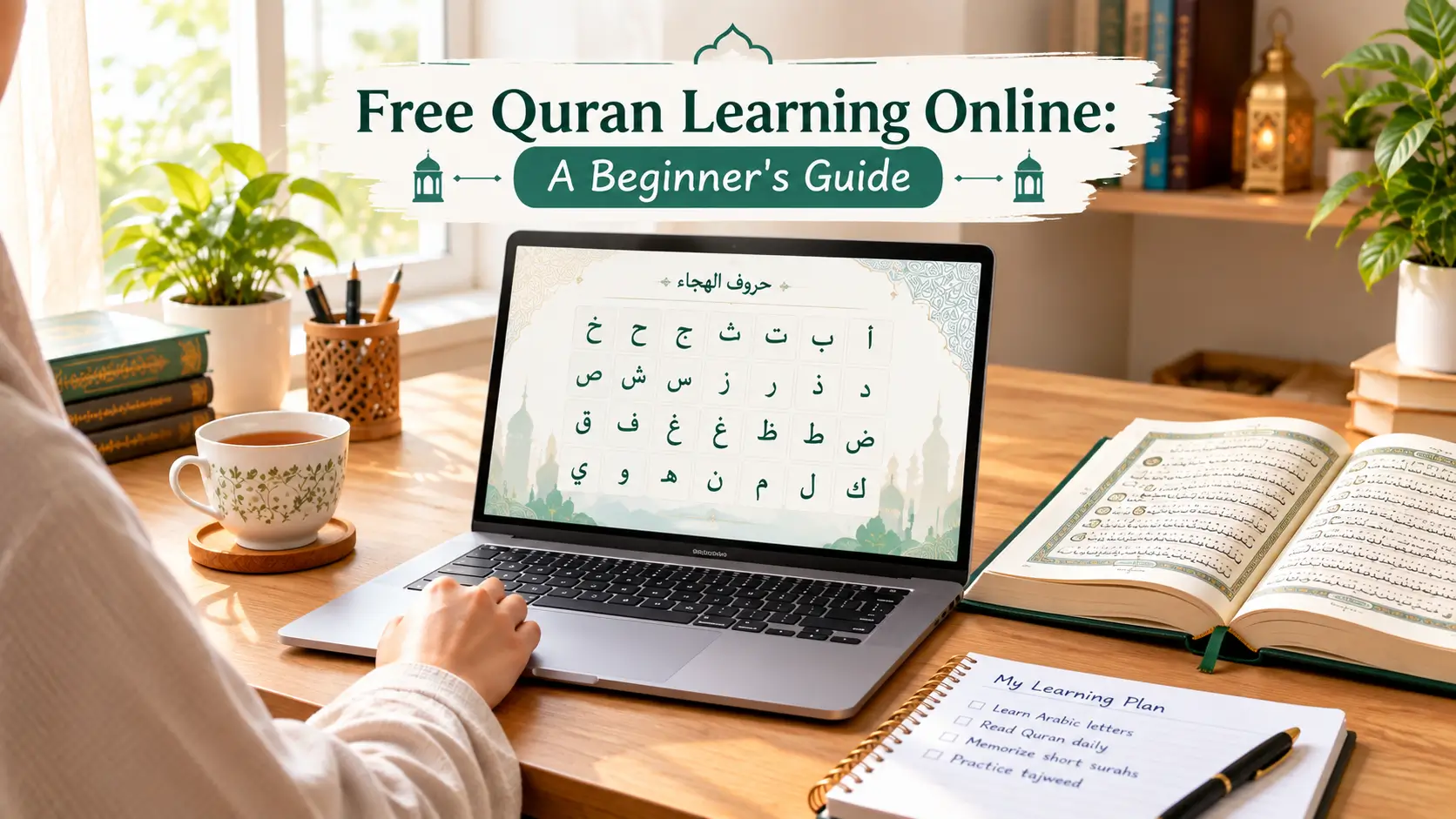
Many adults want to read the Quran but feel stuck. Private tutors often charge $20 or more per hour in the US, and work schedules make fixed class times hard. So people wait, and months turn into years.
Free Quran learning online means studying the Quran through no-cost websites, apps, videos, and live classes instead of paying for private lessons. You can learn Arabic letters, pronunciation, tajweed rules, memorization, and basic meaning at your own pace. Most free options work on a phone, so you can practice at home, during a commute, or on a quick lunch break.
The good news is that you don’t need a big budget or a perfect teacher to begin. This guide shows you what to learn first, which tools are worth your time, and where free options fall short. You will also get a simple 30-day plan you can start today.
summary
Start with Arabic letters and sounds, not memorization. Pick one free course and one free app, and stick with them. Practice 15 to 20 minutes a day. Use free tools to build a base, then add a live teacher for correction when you can.
What You Can Learn for Free (and What You Can’t)
Free resources cover more than most people expect. With free Quran learning online, you can learn:
- The Arabic alphabet and how letters join together
- Noorani Qaida, a beginner primer that teaches letter sounds and reading rules
- Basic tajweed, the rules for reciting the Quran correctly
- Short surahs for memorization
- Translation and basic tafsir (explanation of the verses)
There is one big limit: personal feedback. A video can’t hear your voice. If you say a letter wrongly, you may not notice for months.
Some apps use AI to flag reading mistakes. That helps, but it is not the same as a qualified teacher. Keep this in mind as you plan.
Step 1: Learn the Arabic Letters and Sounds
Arabic has 28 letters. Each letter can change shape depending on where it sits in a word. This confuses many beginners, so go slowly.
Focus on sounds first, not just letter names. Some sounds have no exact English match, like ع (ayn) and ح (haa). Play the audio, pause, and repeat out loud. Your mouth needs practice, not just your eyes.
Here is a simple habit that works. Write each letter by hand in three forms: the start, middle, and end of a word. Ten minutes a day is enough. A realistic goal is to know all the letters and their basic sounds within two weeks.
For lessons, look for Noorani Qaida video series from established Islamic institutes or mosques. Many are free and teach one small lesson at a time.
Step 2: Add Short Vowels and Join Letters
Once you know the letters, learn the short vowel marks. There are three main ones:
- Fatha: a small line above a letter, gives an “a” sound
- Kasra: a small line below a letter, gives an “i” sound
- Damma: a small curl above a letter, gives a “u” sound
Now practice joining letters into simple syllables and words. Read slowly, one syllable at a time. Speed comes later. Many beginners rush this step and end up guessing words instead of reading them.
Step 3: Learn Tajweed Basics
Tajweed means giving each letter its correct sound and length when you recite. Think of it as the “pronunciation rules” of the Quran.
Start with just two ideas. First, learn where sounds come from in the mouth and throat. Second, learn how long to stretch certain vowels, called madd. Leave the advanced rules for later, once your basic reading feels steady.
Here is why this matters. Take the name ar-Rahman. The letter ح (haa) comes from the middle of the throat and sounds different from the English “h.” If a learner says it like a regular English “h,” the sound changes. This is exactly the kind of small mistake a teacher would catch quickly.
Many Quran websites and apps show tajweed with color coding, which helps you spot rules while you read. Color coding is a useful guide, but it doesn’t replace listening to a good reciter.
Step 4: Build a Simple Daily Routine
The best plan for free Quran learning online is a small daily habit, not a big burst of effort once a week.
Here is a realistic example. Picture a nurse in Houston who works three 12-hour shifts a week and can’t join fixed class times. She sets a 15-minute routine before work:
- 5 minutes to review yesterday’s letters or words
- 5 minutes for one new video lesson
- 5 minutes reading aloud
It looks small, but after a month of this she can read simple words and follow Surah Al-Fatihah with audio.
Here is a 30-day plan you can copy:
- Week 1: Arabic letters and their sounds
- Week 2: Short vowels and joining letters
- Week 3: Reading simple words, then Al-Fatihah with audio
- Week 4: Basic tajweed, then short surahs like Al-Ikhlas
Miss a day? Just continue the next day. Don’t restart. Consistency beats perfection.
Step 5: Add Memorization and Meaning
Start with Surah Al-Fatihah, since Muslims recite it in every prayer. Then move to short surahs from Juz 30, the last part of the Quran, like Al-Ikhlas, Al-Falaq, and An-Nas.
Listen to a respected reciter first. Then repeat one verse at a time, and link the verses together once each one feels solid.
Learning the meaning keeps you motivated. Read a translation beside the Arabic text. Quran.com lets you view several translations side by side. Pick translations by known scholars, and if a verse feels unclear, check a trusted tafsir instead of guessing what it means.
Free Tools Compared
Different tools solve different problems. Here is how the main types compare:
| Tool Type | Best For | Main Limit |
|---|---|---|
| Free video courses (YouTube, institute channels) | Noorani Qaida and tajweed lessons | No feedback on your voice |
| Quran websites and apps (like Quran.com) | Reading, audio, translation, tafsir | Doesn’t teach reading from zero |
| AI recitation apps (like Tarteel) | Spotting reading mistakes, memorization practice | Not a replacement for a teacher; some features may be paid |
| Free trial lessons with live tutors | Real feedback from a person | Limited to the trial period |
| Mosque or community online classes | Real teacher and community support | Fixed schedule; larger groups |
Features and pricing change often, so check the current details before you sign up for anything.
Honest Pros and Cons
Free Quran learning online has real strengths, and real limits. Knowing both helps you plan well.
Pros:
- It costs nothing to start, so there is very little risk.
- You learn on your own schedule.
- You can replay a lesson as many times as you need.
- It feels less stressful for adults who are shy about starting late.
Cons:
- There is no personal correction from a real person.
- Too many options lead to “resource hopping,” where you keep switching courses.
- Quality varies, and some content has no clear teacher.
- Free tools rarely give a full roadmap, so you need your own plan.
Common Mistakes to Avoid
Most people who quit free Quran learning online do so because of a few simple mistakes:
- Jumping to memorization too early. If you can’t read the letters well, you will memorize mistakes.
- Switching resources every week. Finish one course before starting another.
- Only reading, never speaking. Say the words out loud every session.
- Trusting color coding alone. Listen to a reciter and copy the sound.
- Skipping review. A short daily review beats a long weekly session.
How to Choose a Trustworthy Free Resource
Not every option for free Quran learning online is reliable. Before you commit to a course or channel, run through this quick check:
- Is the teacher named, with clear training or credentials?
- Does the course move from beginner to advanced in a clear order?
- Does it use audio from well-known reciters?
- Is it clear what is free and what costs money?
- Do real students leave honest reviews?
If a site pushes you to pay right away or hides who teaches, look elsewhere.
When to Add a Live Teacher
Free Quran learning online is a strong start, but a live teacher helps most once you can read basic words. That is usually after 4 to 8 weeks of steady practice.
Even one lesson a week can fix mistakes that apps and videos miss. When you look for a teacher, ask about ijazah, a teaching certificate that traces back through a chain of teachers. Not every good teacher has one, but it is a useful sign of training.
Many online Quran academies offer a free trial class. Use it to test the teacher’s style, and be careful if you feel pressure to pay on the spot. Local mosques and Islamic centers also run online classes, sometimes at low cost. If you live in the US, UK, or Canada, check the time zone before you sign up, since some teachers are based overseas. Prices vary widely, so compare a few options.
FAQs
Can beginners learn the Quran online for free?
Yes, free Quran learning online works well for beginners who want to learn Arabic letters, basic reading, and short surahs, as long as they follow a clear plan and practice daily. For tajweed accuracy, add feedback from a qualified teacher when you can.
Most free courses begin with the alphabet and Noorani Qaida, so no prior Arabic knowledge is needed.
How long does it take to learn to read the Quran?
Most beginners who practice 15 to 20 minutes a day can read simple Arabic words in about four to eight weeks, while reading the Quran smoothly with correct tajweed usually takes several months or longer. Your pace depends on daily practice, your age, and whether you get feedback on your reading.
Don’t compare yourself to others. Steady practice matters more than speed.
Which free app is best for learning the Quran?
No single app is best for everyone, because each one solves a different problem. Quran.com works well for reading, audio, and translations, while apps like Tarteel focus on recitation practice, and video courses are better for learning Noorani Qaida from scratch.
A simple setup is one course for lessons and one app for daily reading.
Do I need to know Arabic before I start?
No, you do not need any Arabic knowledge to begin, because the first lessons teach the alphabet and sounds from zero. Start with the Arabic letters and Noorani Qaida, which are made for absolute beginners, and add vocabulary and meaning once you can read simple words.
Understanding the language deeply is a long-term goal, and you can grow into it step by step.
Can I learn the Quran without a teacher?
You can start without a teacher and make real progress with letters and basic reading, but a teacher is strongly recommended for tajweed. Correct pronunciation is learned by listening and being corrected, which recorded lessons and apps cannot fully do for you.
If a paid teacher isn’t possible right now, look for a community class at a local mosque or a free trial lesson.
Final Thoughts
Free Quran learning online will not replace a teacher, but it gives you a strong, low-risk start. Learn the letters, add vowels, practice tajweed basics, and build a small daily habit. Then add a live teacher when you are ready.
Progress comes from showing up, not from finding the perfect
[…] Free Quran Learning Online […]