

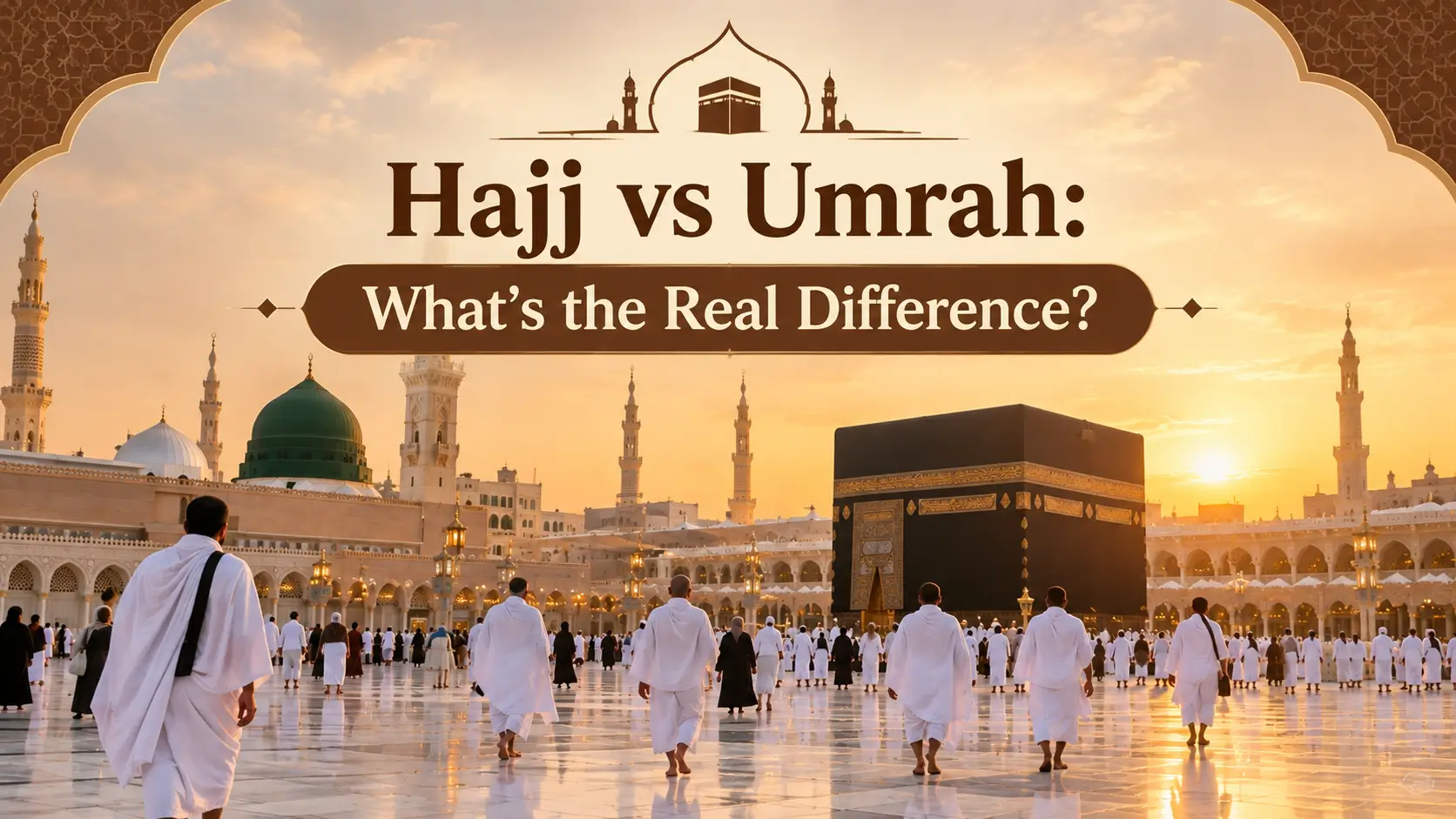
If you’re new to Islamic pilgrimage, the terms Hajj and Umrah can sound like they mean the same thing. They don’t. Mixing them up can lead to real problems — wrong expectations, wrong timing, or even skipping a step that matters.
Understanding the difference between Hajj and Umrah matters whether you’re planning your own trip, helping a family member prepare, or simply trying to understand Islamic practice better. Getting this right affects your travel dates, your budget, and how you prepare spiritually and physically.
In this guide, you’ll learn exactly what separates these two pilgrimages, see a clear side-by-side comparison, and get answers to the questions people ask most often.
Quick definition: Hajj is the mandatory annual pilgrimage to Mecca that every able Muslim must perform once in their lifetime during a fixed set of days in the Islamic calendar. Umrah is a shorter, optional pilgrimage that can be performed at any time of year and involves fewer rituals.
summary
- Hajj is obligatory (for those who are able), happens only during specific days each year, and includes several extended rituals.
- Umrah is optional, can be done any time, and takes just a few hours to complete.
- Hajj is one of the Five Pillars of Islam. Umrah is not.
- Both involve wearing ihram and performing Tawaf, but Hajj adds several additional steps like standing at Arafat and stoning the pillars at Mina.
- Umrah is often used as a way to visit Mecca outside the busy Hajj season.
What Is Hajj?
Hajj is the major pilgrimage to Mecca, Saudi Arabia, and one of the Five Pillars of Islam. This means it’s a core religious obligation, not just a recommended act.
Every Muslim who is physically able and financially capable must perform Hajj at least once in their life. It takes place during a specific window in the Islamic month of Dhul Hijjah, meaning the exact dates shift each year based on the lunar calendar.
Hajj involves several days of rituals, including standing at the plain of Arafat, walking between the hills of Safa and Marwah, and the symbolic stoning of the pillars at Mina. It’s a physically demanding and spiritually intense experience that typically takes five to six days to complete.
For a practical example: a Muslim family in the US might spend a full year saving and planning for Hajj, since it usually requires more time off work, a larger budget, and advance visa applications compared to a shorter trip.
What Is Umrah?
Umrah is often called the “lesser pilgrimage.” It shares some rituals with Hajj but is much shorter and is not mandatory.
Umrah can be performed at any point during the year, which makes it far more flexible for travelers. Unlike Hajj, there’s no fixed date range, so people often choose to go during quieter months to avoid large crowds.
The core steps of Umrah include entering the state of ihram, performing Tawaf (circling the Kaaba seven times), and completing Sa’i (walking between Safa and Marwah). The entire ritual can often be completed in just a few hours, which is why some travelers combine it with a broader trip to Saudi Arabia.
Hajj vs Umrah: Side-by-Side Comparison
Seeing both pilgrimages next to each other makes the difference between Hajj and Umrah much easier to understand at a glance.
| Feature | Hajj | Umrah |
|---|---|---|
| Religious status | Obligatory (Fifth Pillar of Islam) | Optional (Sunnah) |
| Timing | Fixed dates in Dhul Hijjah only | Any time of year |
| Duration | 5–6 days | A few hours to one day |
| Key rituals | Ihram, Tawaf, Sa’i, Arafat, Mina, stoning of pillars | Ihram, Tawaf, Sa’i |
| Crowd size | Millions of pilgrims at once | Varies, generally smaller |
| Typical cost (US travelers) | Higher, often several thousand dollars | Lower, more budget-flexible |
This table highlights the biggest practical differences: obligation, timing, and how much time and money each trip typically requires.
Why the Difference Matters for Planning
Knowing the difference between Hajj and Umrah isn’t just a religious detail — it directly shapes how someone plans their trip.
Because Hajj happens during a fixed window each year, flights, hotels, and visas get booked months in advance, and prices rise sharply as the dates approach. Umrah, on the other hand, allows much more flexibility, so travelers can pick cheaper travel seasons and avoid the biggest crowds.
Here’s a real-world example: a traveler based in Chicago might choose to perform Umrah during a slower travel month, spending under $2,000 total, while the same traveler planning Hajj the following year might need to budget $6,000 or more due to peak-season pricing and the longer stay required.
This is also why many people perform Umrah multiple times throughout their life, while Hajj is typically a once-in-a-lifetime obligation (though it can be repeated voluntarily).
Shared Rituals Between Hajj and Umrah
Even though Hajj and Umrah differ in length and obligation, they do share some common elements, which is part of why people confuse them.
Both pilgrimages require entering a sacred state called ihram, which includes simple, unstitched white garments for men and modest clothing for women. Both also include Tawaf, the act of circling the Kaaba seven times, and Sa’i, walking briskly between the hills of Safa and Marwah.
The key difference is that Hajj adds several extra steps on top of these shared rituals — including the Day of Arafat, spending the night at Muzdalifah, and the stoning of the pillars at Mina — none of which are part of Umrah.
Common Mistakes People Make
A few misunderstandings come up repeatedly when people research this topic, so it helps to clear them up directly.
Mistake 1: Thinking Umrah can replace Hajj. Umrah does not fulfill the religious obligation of Hajj. Even someone who has performed Umrah multiple times still needs to complete Hajj separately if they are able to.
Mistake 2: Assuming both happen during the same season. Hajj only happens during a fixed window each year. Umrah has no such restriction and can be done anytime, including outside of Hajj season.
Mistake 3: Believing the rituals are identical. While there’s overlap, Hajj includes several additional and more demanding rituals that Umrah does not require.
Frequently Asked Questions
What is the main difference between Hajj and Umrah? Hajj is a mandatory pilgrimage performed once a year during fixed dates, while Umrah is optional and can be done anytime. Hajj also includes more rituals and typically takes several days, whereas Umrah can be completed in just a few hours.
Can Umrah be performed instead of Hajj? No, Umrah cannot replace Hajj as a religious obligation. Even if someone has performed Umrah many times, they are still required to complete Hajj separately if they are physically and financially able to do so.
How long does Hajj take compared to Umrah? Hajj typically takes five to six days due to its multiple stages, including standing at Arafat and staying at Mina. Umrah, by contrast, usually takes just a few hours since it only involves ihram, Tawaf, and Sa’i.
Is Umrah cheaper than Hajj? Yes, Umrah is generally much cheaper than Hajj because it requires less time, smaller crowds mean more flexible pricing, and it can be booked during off-peak travel months. Hajj costs are typically higher due to peak-season demand and a longer stay.
Do men and women perform Hajj and Umrah the same way? Both men and women perform the same core rituals, but clothing requirements differ. Men wear two simple unstitched white cloths, while women wear modest, loose-fitting clothing that covers the body, without a specific mandated color.
Can a person perform Umrah multiple times in one year? Yes, Umrah can be performed as many times as someone wishes throughout the year, since there is no fixed date restriction. This is different from Hajj, which happens only once annually during a specific set of days.
Final Thoughts
The difference between Hajj and Umrah comes down to obligation, timing, and scale. Hajj is a mandatory, once-in-a-lifetime pilgrimage tied to fixed dates and multiple rituals, while Umrah is a shorter, flexible act of worship that can be done anytime.
Understanding this difference helps with realistic planning — whether that means budgeting further ahead for Hajj or choosing a quieter, more affordable time of year for Umrah.